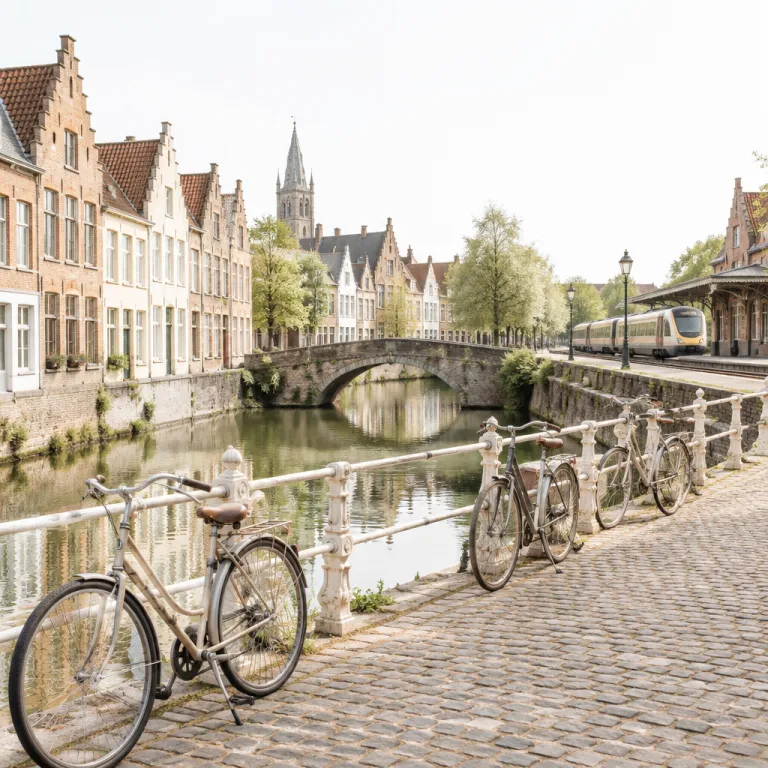
Why Bruges works better without a car for luxury travelers
Bruges was shaped long before the first car appeared on any cobbled quay. The historic centre is a compact oval, and you can cross the entire city centre on foot in around a 30 minute walk without rushing children between sights. For a premium family planning a refined trip, this makes Bruges city logistics unusually gentle and turns every short stroll into part of the cultural experience.
Arriving by train from Brussels to Bruges is usually the best choice for a luxury stay without car stress. Direct Belgian Railways InterCity services link central Brussels and Bruges train station in roughly one hour, with frequent departures from both Brussels Airport-Zaventem and Brussels South (Bruxelles-Midi) for seamless travel. According to the Belgian Railways timetable, there are typically two to three trains per hour on this route during the day, which gives you flexibility if a flight or connection runs late.
From the Bruges train platforms, it is about 1.5 km to the Markt, and most five star and premium hotels in the city centre arrange luggage friendly routes or a short taxi hop if you prefer not to walk with suitcases. Local taxis from the station to central hotels usually cost in the region of €10–€15, depending on traffic and time of day. One concierge described the ideal arrival rhythm as “train, ten minute walk through the park, check in, then coffee on the canal,” which captures how quickly you can shift from transport to relaxation.
Many American visitors still ask whether they should rent a car in Belgium for a multi day itinerary. For Bruges city breaks, a car Bruges combination usually adds cost, parking stress and no real benefit, especially when public transport and taxis cover the few journeys that walking cannot. If you are continuing your trip beyond Bruges without losing time, trains to Ghent, Antwerp and the coast make car free day trips straightforward while keeping your base in a calm, central property.
Luxury hotels in Bruges understand that their guests often arrive without car plans. Several high end addresses near the city centre offer clear directions from the train station, explaining whether a five to ten minute walk or a short bus ride is more comfortable with children. When you book, ask the concierge to outline the best route from Brussels Bruges trains or from Brussels Airport, and they will usually factor in stroller needs, cobblestones and your arrival time of day.
For those who still choose to drive, the city has structured its car park offer to keep vehicles at the edge of the medieval core. Underground parking Bruges facilities such as Centrum-Station or Zand allow you to park once and then enjoy Bruges without car worries, using your hotel as a base for walking and cycling. The most relaxed premium stays treat the car as a static object in a secure car park while you rely on Bruges transport options that match the slow travel rhythm of the canals.
From Brussels Airport to Bruges: trains, transfers and stress free arrivals
Flying into Brussels Airport is the most common entry point for long haul guests heading to Bruges city. From the airport level below arrivals, Belgian Railways runs direct trains to Bruges train station via central Brussels, usually every hour, with easy connections at peak times. This makes a Bruges without car itinerary entirely realistic even with younger children and several suitcases.
The typical route from Brussels Airport to Bruges involves a short hop to Brussels South or central Brussels, then a direct InterCity train to the coast bound line. Travel time from Brussels to Bruges is about one hour, and the total journey from the airport Bruges combination usually sits around ninety minutes door to door. For premium families, first class on these trains offers slightly wider seats and a calmer carriage, which can be worth the modest extra cost on a long day of travel.
If you prefer a private transfer, pre booked taxi services meet you at Brussels Airport arrivals and drive directly to your hotel in Bruges city centre. This car based option is comfortable but often slower than the train during busy periods, and parking near your hotel may still require using a central car park on the edge of the old town. Many luxury properties will advise honestly whether a taxi or train suits your arrival time, especially if your trip includes late evening landings or tired children.
Families sometimes worry about managing luggage on the Brussels Bruges train with strollers and bags. In practice, the platforms at both Brussels South and Bruges train station have lifts, and the walk from the Bruges station to the historic centre is a flat, tree lined route that works well with pushchairs. If you prefer not to walk, De Lijn bus services run every few minutes from the station to the city centre, and taxis wait outside the main exit for a quick five minute ride.
Once you reach your hotel, you can settle into a car free rhythm that suits Bruges without car expectations. Many premium properties near the Markt or Burg squares, such as those reviewed on stay-in-bruges.com, are within a five to ten minute walk of key cultural landmarks, meaning you rarely need any motorised transport during your stay. To understand how deeply the city integrates heritage and infrastructure, read the analysis of the underground beer pipeline in the article on what the underground beer pipeline tells you about Bruges and brewing, which shows how logistics move underground while the streets remain human scaled.
Walking Bruges: cultural landmarks within a 30 minute radius
Once you are checked into your hotel, Bruges without car logistics become very simple. The entire UNESCO listed centre fits into a compact area, and you can walk from the train station park to the northern canals in about a 30 minute walk at a relaxed pace. This makes it easy to link major cultural landmarks into one coherent day without needing any bus or taxi.
Start at the Markt, where the Belfry towers over the city centre and offers panoramic views across Bruges city rooftops. From here, a short stroll brings you to the Burg square, home to the Basilica of the Holy Blood and the ornate City Hall, both essential stops for any visit Bruges itinerary. Families can then wander along the canals towards the Rozenhoedkaai, where the reflections of gabled houses and church spires create one of the most photographed corners of Belgium.
From these central points, most other highlights sit within a ten to fifteen minute walk, including the Groeningemuseum, the Gruuthusemuseum and the Church of Our Lady with its Michelangelo sculpture. Even with children, you can structure your day trips inside the city as a series of short segments, returning to your hotel for a rest between cultural visits. This car free pattern suits premium families who prefer to avoid long stretches of walking but still want to feel immersed in Bruges without losing time in vehicles.
Luxury hotels in the heart of Bruges often position themselves as ideal bases for exploring the city centre on foot. Properties around the Burg and Markt squares, including refined options like Martin’s Brugge, place you within a two or three minute walk of major sights, and you can read a detailed review of this refined city centre comfort beside the Belfry on this in depth city centre hotel review. Staying this central means that even evening concerts at the Concertgebouw or late dinners in quiet side streets remain an easy stroll rather than a logistical exercise.
For culture focused travelers, temporary exhibitions can shape the rhythm of a trip. When a major show such as the Bigger Picture exhibition runs in Bruges, planning your walking route around the venue and nearby cafés keeps the day relaxed and car free, and you can see how this works in practice in the guide to what to see before Bruges’ medieval blockbuster closes. Because the city is so compact, even last minute changes to your plan rarely require any transport beyond your own feet.
Cycling, buses and canal boats: elegant alternatives to driving
Walking covers most needs in Bruges, but cycling adds another graceful layer to a car free stay. The city has promoted cycling and discouraged car use since the nineteen seventies, creating car reduced zones and calm streets that feel safe for older children on bikes. The municipal mobility plan continues to prioritise pedestrians and cyclists, and many streets in the inner ring now have speed limits of 30 km/h or less, which contributes to a noticeably relaxed atmosphere.
Using a bicycle, you can extend your cultural map beyond the immediate city centre. A gentle ride along the canals towards Damme or the windmills on the eastern ramparts turns a simple trip into a slow travel experience, with frequent stops for photos and snacks. For families, child seats and cargo bikes are widely available, making it realistic to explore Bruges without car dependence even with younger children who cannot yet cycle independently.
Public transport inside Bruges is mainly handled by De Lijn buses, which link the train station, city centre and residential districts. These buses are useful on rainy days or when a long walk back from a museum feels too much for tired legs, and they integrate smoothly with Belgian Railways tickets on some passes. Taxis are available but rarely essential inside the compact Bruges city core, so most premium travelers use them only for late night returns or specific transfers.
Canal boats are often marketed as sightseeing, but they also function as a gentle form of transport between different quarters of the city. Boarding near the Rozenhoedkaai and disembarking closer to the Begijnhof or Minnewater allows you to shift from one cultural cluster to another without touching a car or bus. This pattern fits perfectly with a Bruges without car philosophy, where the journey itself becomes part of the day rather than a gap between attractions.
For those considering regional day trips, trains remain the most efficient option from Bruges train station. Services to Ghent, Antwerp or the coastal tram at Oostende make it easy to plan one or two day trips without renting a car, and you can return to your Bruges hotel each evening. This combination of walking, cycling, buses and trains creates a layered transport network that supports luxury travel without car reliance while keeping the focus on culture and comfort.
Parking reality: where cars belong when you insist on bringing one
Some travelers still arrive in Bruges by car, often as part of a longer road trip across Belgium or neighbouring countries. When that happens, the key to a calm stay is to treat the vehicle as a tool for arrival and departure only, not as daily transport inside Bruges city. The medieval street pattern, narrow canalside lanes and car reduced zones mean that driving through the centre is rarely pleasant and often slower than walking.
The city manages several large car parks around the edge of the historic core, designed to keep through traffic away from the most fragile streets. Centrum-Station, located beside the train station park, is one of the best options for visitors who want to leave their car for one or more day trips inside Bruges without moving it. From this car park, it is about a ten to fifteen minute walk to the Markt, or a short bus ride if you prefer not to walk with luggage.
Parking Bruges tariffs in these central facilities are generally more reasonable than on street parking, and some hotels offer discounted rates when you validate your ticket at reception. As an indication, daily caps in the main underground car parks are often around €15, while on street spaces in central zones can be significantly higher for the same period. However, when you add up the daily parking cost, potential congestion charges and the stress of navigating narrow streets, a car Bruges combination often feels less attractive than arriving by train.
Inside the city centre, on street parking is limited and heavily regulated, with short maximum stays and resident priority in many zones. This reinforces the logic of a Bruges without car approach, where you park once and then rely on walking, cycling and public transport for the rest of your trip. If you must use a taxi for a specific journey, hotel concierges can arrange reputable services that know how to navigate the central streets efficiently.
For those planning a wider Belgian itinerary, consider structuring your trip so that the car free segment aligns with your Bruges stay. You might rent a car after leaving Bruges by train, picking it up in another city where parking and driving are less constrained, or return a rental in Brussels South before boarding the Brussels Bruges train. This strategy keeps the most delicate part of your journey, the time inside Bruges city centre, aligned with the strengths of the local transport network rather than fighting against it.
Family friendly Bruges: strollers, slow travel and hotel choices
Premium families often worry that a car free city might be hard with young children, but Bruges without car realities are surprisingly gentle. The main challenge is not distance but surface, because cobblestones can make stroller wheels rattle on some streets. Choosing a hotel within a short minute walk of the Markt or Burg reduces the need for long pushes and keeps nap returns quick.
When booking, look for properties that clearly explain their distance from the train station and key sights in metres rather than vague phrases. A hotel that sits within a ten minute walk of the station and a five minute walk of the main squares will make your entire trip feel easier, especially if you are arriving by Bruges train from Brussels with tired children. Many high end hotels in Bruges city centre now highlight their proximity to public transport and cultural landmarks as a core part of their value proposition.
Inside the city, plan your day so that cultural visits alternate with playgrounds, parks and quiet cafés. The Minnewater park, the Astridpark and the green ramparts offer space for children to run while adults enjoy a slower rhythm, all within a short walk of major museums and churches. This pattern of short walks and frequent pauses fits perfectly with a Bruges without car approach, where you never feel pressured to cross long distances just to reach the next sight.
For meals, many family friendly restaurants sit within a compact radius of the Markt and Burg, meaning you can choose based on quality rather than proximity to a car park. Evening walks back to your hotel become part of the experience, with illuminated canals and quiet side streets replacing the usual hunt for parking. If children are exhausted, a short taxi ride within the city centre remains an option, but most families find they rarely need it.
When planning day trips beyond Bruges, trains again offer the most family friendly option. Direct services from Bruges train station to Ghent or the coast are frequent, and journey times are short enough that children do not become restless, especially if you travel outside peak commuter hours. Returning each evening to a familiar hotel in Bruges city centre keeps the trip anchored, while the car free structure reduces stress for parents and keeps the focus on shared experiences rather than logistics.
Using Bruges as a car free base for wider Belgian culture
Bruges is not only a destination but also an excellent base for exploring other parts of Belgium without a car. The city’s train station connects efficiently to Ghent, Antwerp, Brussels and the coast, allowing you to plan one or two day trips while keeping your luggage in a single hotel room. This pattern suits premium travelers who prefer to unpack once and then range outwards by train.
From Bruges train station, InterCity services reach Ghent in around twenty five minutes and Brussels in about one hour, making both cities realistic day trips. You can spend a day in central Brussels visiting the Grand Place, Sablon and major museums, then return to the calmer atmosphere of Bruges city in the evening. For those flying home, planning your final night in Bruges and then taking an early train to Brussels Airport often feels more pleasant than staying near the terminals.
The Belgian Railways network also opens up coastal options, with frequent trains from Bruges to Oostende and Blankenberge. From these hubs, the coastal tram runs along the North Sea, offering a relaxed, car free way to explore beaches and seaside towns before returning to your Bruges hotel. This combination of city culture and coastal air, all managed without car rentals, aligns well with a slow travel philosophy that values depth over speed.
For travelers considering more complex itineraries, such as combining Bruges with Amsterdam or Paris, high speed trains from Brussels South integrate smoothly with regional services from Bruges. You can travel from Bruges to central Brussels, change to a Thalys or Eurostar service and reach another major city without ever needing a car park. This rail based structure keeps your trip coherent and reduces the number of variables that can go wrong.
Throughout these movements, Bruges without car remains the anchor concept. Your hotel in Bruges city centre becomes a stable base, while trains, occasional buses and your own feet handle the rest of the transport. For premium families and luxury travelers, this approach delivers a calmer, more elegant experience, where time is spent in museums, cafés and along canals rather than in traffic or searching for parking.
Key figures for car free travel in Bruges
- Bruges train station sits approximately 1.5 km south of the Markt, which translates into about a 20 minute walk for most visitors, making it realistic to arrive by train and walk to many central hotels.
- Direct trains between Brussels and Bruges typically take around 60 minutes, with multiple departures per hour during the day, allowing flexible planning for arrivals from Brussels Airport and Brussels South.
- The historic centre of Bruges can be crossed on foot in roughly 30 minutes from north to south, meaning that most major cultural landmarks sit within a 15 minute walk of each other.
- Public underground car parks such as Centrum-Station offer hundreds of spaces at daily rates that are often lower than on street parking, encouraging visitors to leave their cars parked and explore on foot.
- Regional trains from Bruges to Ghent take about 25 minutes, and services to Brussels take about 60 minutes, making both cities realistic day trips without renting a car.
FAQ about visiting Bruges without a car
Is a car useful inside Bruges city centre ?
A car is rarely useful inside Bruges city centre because the historic core is compact, heavily traffic calmed and designed around pedestrians and cyclists. Most cultural landmarks sit within a short walk of each other, and public transport or taxis cover the few journeys that walking cannot. For most visitors, parking the car on arrival and exploring on foot or by bicycle is the most efficient approach.
How do I get from Brussels Airport to Bruges without a car ?
The easiest way to travel from Brussels Airport to Bruges without a car is by train. Belgian Railways operates frequent services from the airport to Brussels South or central Brussels, where you can connect to a direct InterCity train to Bruges. The total journey usually takes around ninety minutes, and lifts at both ends make it manageable with luggage and children.
Where should I park if I arrive in Bruges by car ?
If you arrive in Bruges by car, the best option is to use one of the large underground car parks on the edge of the historic centre, such as Centrum-Station or Zand. These facilities offer secure parking at reasonable daily rates and sit within walking distance of the main squares. Once parked, you can explore the city on foot, by bicycle or using local buses.
Is Bruges suitable for families with strollers without a car ?
Bruges is generally suitable for families with strollers, even without a car, because distances are short and many routes are flat. Some streets have uneven cobblestones, so choosing a hotel close to the main squares reduces the need for long walks on rough surfaces. Parks, playgrounds and frequent cafés provide natural breaks, making it easier to manage young children throughout the day.
Can I use Bruges as a base for day trips without renting a car ?
Bruges works very well as a base for day trips without renting a car because its train station connects efficiently to Ghent, Brussels, Antwerp and the coast. Journey times are short enough to allow full days in other cities while returning to your Bruges hotel each evening. This rail based approach keeps logistics simple and avoids the cost and stress of driving and parking in multiple urban centres.